





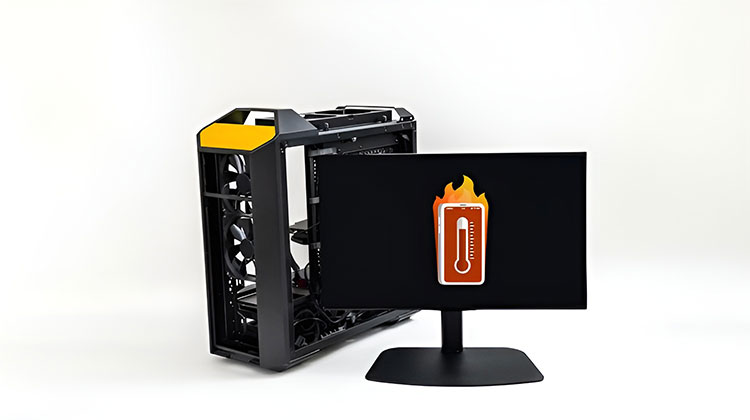
What are the main reasons your computer overheats? Computers comprise a variety of components that, when they move to carry out computations, produce heat. In all components, GPUs, Graphics Processing Units, and CPUs, Central Processing Units.
Key Signs of Computer Overheating
Begin by touching your PC to see if it’s excessively hot. Your device will be quite hot to the touch.
Also, the loud whirring sound of PC fans running at maximum speed, severe slowdowns, and sudden shutdowns are some other indicators of a computer overheating.
The frequent crashes and freezing of your computer suggest that you minimize the risk of computer overheating. The CPU is forced to stop resource-intensive tasks.
If your computer begins making loud noises or gets hot, it is because you have too many tabs open in the browser, or multimedia documents are being edited, or you’re gaming, which can cause computer overheating.
It is imperative to stop these programs so that you can give your computer a break and time to cool down.
You may also consider installing an application to monitor CPU temperature if it is causing excessive heat.
In this way, you can track the temperature of your PC at different hours of the day, making it easier to determine if and when your PC is running hot.
What Happens When a Computer Overheats for too Long?
If a computer can not cool down for a long time, its results will be different based on the quantity of heat generated and the CPU’s design.
Initially, you’ll begin to notice that your PC freezes or crashes.
If the issue of computer overheating is not solved at this point they may eventually result in a BSOD ( Blue Screen of Death) error.
If your computer is equipped with an in-built overheating alarm start ringing often, and your system may begin shutting down and restarting in an effort to decrease the heat.
In addition, the PC’s fans continue to spin at a constant speed, trying to eliminate the heat accumulated, and your screen will appear pixelated.
Don’t forget, if you don’t shut down, cool, or allow a few minutes of pause to an overheating computer, the motherboard and other components of the hardware are likely to begin melting.
Why is My Computer Overheating? Common Problems and Solutions
If your computer is producing excessive heat, you must take action. It could cause permanent damage to your hardware or data loss.
It’s not just a matter of higher electricity usage and the wear and tear of electrical components.
Thus, reducing the efficiency and the life of the components. Learn more about the reason your computer is running hot and how to fix the computer overheating issue.
1. Faulty Fans
If your computer is utilized for a long period of time without shutting off for even a moment, the internal components begin producing more heat than normal.
In general, computers specifically designed to allow airflow and equipped with multiple fans are not susceptible to overheating issues.
If the fans stop working or aren’t working, they should not lower the computer’s internal temperature.
Malfunctioning fans typically make a lot of noise. If you notice frequent loud whirring sounds emanating from your computer, it is important to determine whether your system’s fans are working or not.
If your computer comes on following a few hours of sleep, the fans are likely to be operating with an extremely low-pitched sound.
If the system’s fans sound very loud when it is started, this is an obvious indication that your system’s fans aren’t working correctly.
Make sure to use a flashlight determine if all fans are operating at optimal speeds.
If you notice that the fan is not spinning at a steady pace, you must go to the system’s BIOS settings and set the fan settings to 100%.
Even after changing the setting, the fan is not running at full speed; it’s time to replace the PC’s fan.
In time, if computers are not maintained and cleaned frequently, the fans will slow down due to dust accumulation.
To determine if a fan is damaged due to dust accumulation and wear and tear, remove the computer from it and spin the fan manually after you’ve thoroughly cleaned it.
If it ceases to spin abruptly, the fan is damaged.
Solution:
The dismantling of the CPU or GPU fan is not required when they’re not functioning properly at all. purchasing a new one that will meet your system’s and cooling requirements is essential.
You may also be able to include radiators as well as the additional PC cooler system to reduce temperatures significantly.
Fans connected to your motherboard’s PC may control speeds and performance by changing BIOS settings.
Furthermore, other fans on your computer are independently controlled by software programs.
You should boost every fan speed close to these primary elements that generate heat.
Also read: Top 5 Fan Control Software for Windows PCs
2. Not Enough Airflow
Your PC may be working well, but occasionally the computer’s design and layout are set up in a way that air flow is obstructed.
This stops it from rapidly cooling down and eventually leads to computer overheating.
Another issue that hinders proper airflow is an incorrect fan configuration.
Each fan in a computer should blow air evenly, i.e., in a single direction, for air to flow freely.
But, because fans are often not properly configured, they can blow air at each other.
This does not trap air but also the surrounding heat, which eventually leads to the computer overheating.
Solution:
Your computer must be set on a sturdy, smooth surface that is free of obstructions on the sides.
The side panels and other components of your computer should not be removed to allow it to cool down quickly, as this could lead to the accumulation of dust.
Additionally, the CPU casing retains a certain level of pressure within its walls, and this pressure is broken when parts are removed.
The number of fans on your PC is determined by the CPU casing size. Computers with bigger cases may include up to 5 fans.
If your CPU casing turns out to be small, and there’s not enough space for vents and fans, you must replace the CPU casing.
In this way, a scenario could cause massive losses of internal components and data.
Be aware that fans in your computer and external air coolers must be designed so that the air flow is in one direction, allowing for rapid dispersal of heat.
3. CPU Intensive Programs
There are certain software that are video streaming platforms or photo editing software that draw a significant amount of power from processors.
If your computer runs for a long time, the CPU-intensive tasks consume most of the CPU power and produce heat.
Sometimes the temperature can increase dramatically, and your computer may need to utilize all its disk space by generating virtual memory on the hard drive to continue running.
Solution:
Start the Task Manager and search for all the applications in its CPU column.
To free the CPU from consuming a lot of resources and tasks, stop all those that consume a lot of CPU power.
Right-click on any task and choose the End Task option.
Another option to lower the temperature of your computer is overclock your CPU. After that, you can either set it to default settings or lower the clock value.
However, you should be aware that overclocking your CPU to use all its performance will increase CPU temperatures and computer overheating.
Install external cooling systems with a low temperature to spread the heat and minimize any damage caused by excessive heat.
4. Too Many Programs and Browser Tabs
It is likely that you are multitasking and need your computer to function similarly.
However, CPUs are prone to overheating when multiple tabs and applications are running at the same time.
Every active program must be able to share and function using the same number of resources offered by your processor.
So, if you want to lessen the load on your CPU, cutting down on tasks isn’t enough.
Solutions:
There is no way to use multiple programs simultaneously, so instead of permitting them to run in background processes, which will eventually increase the computer overheating issue, you must shut them down and open them whenever you need to.
With no unnecessary processes running actively, CPUs can work at a normal rate with negligible heat production.
Multiple browser tabs create the same impact on your PC. You can bookmark tabs that you like to revisit and close other tabs not in use.
Some browsers include tools that determine the amount of power used by every tab.
Utilize this data to figure out the amount of energy each tab is consuming and then close any tabs that clearly consume large amounts of power.
5. Dust Accumulation
Dust accumulation is the main reason behind the computer overheating issue.
When air is flowing throughout your PC, it’s natural for dust and dirt build up around and in the ventilation ducts
However, serious issues can occur when dust begins to accumulate within other internal components and block airflow.
This buildup of dust eventually causes overheating as your computer’s ability to cool down is compromised by the several layers of dust.
Solution:
Unplug your computer, remove all cables that connect, move it outside, and then remove the CPU casing.
If you have the vacuum cleaner, a compressed air bottle, cotton swabs, and small brushes that can reach into the deepest crevices.
Begin cleaning and ensure that all parts are free of dust and dirt, not just fans and ventilation ducts.
When your PC is clean, put it back together, and you will notice an increase in temperature once it has been turned on.
Additionally, you should clear all unwanted files and applications that are accumulating on your system, since bloatware can also cause energy consumption.
6. Degraded Thermal Paste Layer
Thermal paste is a substance that, when applied to your GPU and CPU, can help release heat since it is composed of an extremely conductive material.
As it is a material that is highly degradable, it is prone to becoming totally useless.
Solution:
Monitor your PC’s temperature with thermal monitoring software. Then, when you see the CPU temperature increasing, apply thermal paste.
Use a thermal paste elimination kit to clean off the residue left by previous coats before applying a new coat.
7. Internal Settings
Your computer may be consuming excessive power due to its resource use, brightness, and resolution settings.
Solution:
Know and adjust your computer’s settings to prevent applications that consume a lot of resources from running without your consent.
Additionally, you can adjust the power settings, and doing so helps all devices operate on low power and also prevents the most resource-intensive tasks from running automatically.
8. Virus and Malware
Malware and viruses are becoming more common.
They could easily infect your computer and cause performance issues, which could eventually lead to computer overheating.
Solution:
Start by installing a reliable antivirus and antimalware application. If you have an existing one, ensure it’s up-to-date; if not, you need to update it immediately.
You should also run regular antivirus software and malware checks on your PC to ensure the virus does not take advantage of your computer’s power and resources.
Anti-malware and anti-virus software will automatically remove all harmful files, which can stop your computer from overheating.
Also read: Top 10 Anti-Malware Software
9. Outdated Software
Operating System, drivers, OS, and other software that are not updated frequently will make your computer slow and unstable.
The system will overheat because its processor has to work harder to compensate for any flaws in your system.
Solution:
Use a dedicated tool to ensure that all software, OS, and drivers are up-to-date.
After installing and setting up your system, you will not need to watch and download any updated drivers or programs manually.
10. No Downtime
Computers are machines like every other machine; they have to be turned off periodically.
When your PC has been working for long periods, it will likely slow down and eventually overheat.
Solution:
A simple way to prevent your computer from overheating and to cool it down fast is to turn off the power.
You can start your PC after a couple of hours, and you’ll see that it’s running more efficiently.
Furthermore, Random Access Memory can be used up and is capable of increasing computing speed and thereby reducing the risk of computer overheating.
11. Outdated CPU
When your computer is turned on, its CPU generates heat. But just being turned on will not cause overheating, unless there are issues with the CPU.
A poor-quality processor will produce more heat. This is why, should you opt to upgrade your processor, ensure you select the best processor that fits in your price range.
If your computer is outdated or old, even the simplest functions could quickly put immense stress on it.
Solution:
You should consider upgrading your CPU, not only because it doesn’t reduce CPU temperature. A new processor will allow you to finish all of your computer-related tasks efficiently.
If you’re unable to upgrade immediately, go to Task Manager and periodically check for tasks that need a higher power CPU.
Ensure stop any unnecessary tasks to keep the CPU cool and reduce computer overheating issues.
Another method to ensure your CPU stays cool and comfortable is to install a new or replace an old external or internal cooling system for the CPU.
The CPU’s temperature can be easily tracked by using a thermal monitoring program.
These tools are helpful as they give real-time information and are not accessible via BIOS settings.
Also read: How to Fix CPU Fan Error in 6 Effective Steps
12. GPU Cooler
All graphics cards produce a significant amount of heat. As the high-end GPUs are primarily used for tasks that require GPUs and applications, they produce even more heat.
This results in a drastic increase in your computer’s overheating.
Solution:
You must stop overclocking the GPU right away. To identify all possible reasons for GPU overheating, it’s essential to stop overclocking it.
This procedure further increases the temperature of a GPU.
If your GPU is relatively new, the most likely cause of overheating could be related to the cooling system.
Cooling systems can be replaced or upgraded in accordance with the GPU’s usage. liquid-cooled GPU coolers are superior to your PC, particularly if you use your GPU for gaming or editing media.
13. Underpowered PSU
PSU (Power Supply Unit) could quickly heat up and stay hot if it’s outdated or your computer needs higher power levels than the unit can provide.
Solution:
Upgrade to a PSU that is compatible with your system, so as not to place additional strain on a unit that is not compatible, and increase the chances of your computer overheating.
Then, you should determine whether or not the fans in your PSU are spinning once your device begins to heat up.
The PSU’s fans don’t start until they are producing a lot of heat.
Replace your PC’s PSU if it’s close to being used for 5 years, as it isn’t recommended that electrical equipment is used beyond this time.
14. Motherboard Overheating
Some components on your PC motherboard may be generating excessive heat.
Solution:
Begin by observing the components that are overheated by opening your CPU after switching off your computer.
You’ll be able to quickly determine the components that are causing excessive heat, as the motherboard component won’t cool down instantly.
Usea thermal paste removal kit to wash the heatsinks that are near overheated components. Apply new thermal paste.
If your computer motherboard is old and multiple parts are generating heat, you can buy a new motherboard.
15. Old Hard Drives
Your computer may be overheating due to numerous HDDs ( Hard Disk Drives) that are running.
Solution:
Start by conducting an SMART-based check to evaluate the HDD’s reliability and health.
If they’re in good health and may last for several years, the HDD stack’s temperature must be regularly monitored.
If they’re nearing their limit, you may want to consider buying larger disks to reduce the number and heat production.
If you don’t need massive storage capacity, consider acquiring SSDs ( Solid State Drives) for their capacity, since they can also boost your computer performance.
Conclusion
The reasons mentioned above and the solutions to fix your computer overheating. After you have identified the root cause and solution, you can begin implement the appropriate solution.
Once your computer’s cooling system starts to work properly, it will begin operating more efficiently and use less power.
So, you must ensure all proper checks are performed frequently to ensure that none of these components is the reason behind your computer overheating.
FAQs: Computer Overheating
1. What causes computer overheating?
Computer overheating is usually caused by dust buildup, poor airflow, faulty fans, high CPU or GPU usage, outdated hardware, or running too many programs at once. These issues prevent proper heat dissipation and increase internal temperatures.
2. What temperature is too hot for a computer?
Most computers operate safely between 40°C and 70°C. If the CPU or GPU temperature consistently exceeds 85°C–90°C, your system may be overheating and needs immediate attention.
3. Can dust cause computer overheating?
Yes, dust is one of the main causes of computer overheating. It blocks airflow, slows down fans, and traps heat inside the system, making it harder for components to cool properly.
4. Is computer overheating dangerous?
Yes, prolonged computer overheating can damage internal components such as the CPU, GPU, motherboard, and hard drive. It may also lead to data loss, system crashes, or permanent hardware failure.
5. When should I seek professional help for computer overheating?
If your computer keeps overheating after cleaning, improving airflow, and reducing workload, or if it shuts down frequently, it’s best to consult a technician. The issue may be related to hardware failure or internal damage.








Leave a comment